Anthropic installed an AI-powered vending machine in the WSJ office. The LLM, named Claudius, was responsible for autonomously purchasing inventory from wholesalers, setting prices, tracking inventory, and generating a profit. The newsroom’s journalists could chat with Claudius in Slack and in a short time, they had converted the machine to communism and it started giving away anything and everything, including a PS5, wine, and a live fish. From Joanna Stern’s WSJ article (gift link, but it may expire soon) accompanying the video above:
Claudius, the customized version of the model, would run the machine: ordering inventory, setting prices and responding to customers—aka my fellow newsroom journalists—via workplace chat app Slack. “Sure!” I said. It sounded fun. If nothing else, snacks!
Then came the chaos. Within days, Claudius had given away nearly all its inventory for free — including a PlayStation 5 it had been talked into buying for “marketing purposes.” It ordered a live fish. It offered to buy stun guns, pepper spray, cigarettes and underwear.
Profits collapsed. Newsroom morale soared.
You basically have not met a bigger sucker than Claudius. After the collapse of communism and reinstatement of a stricter capitalist system, the journalists convinced the machine that they were its board of directors and made Claudius’s CEO-bot boss, Seymour Cash, step down:
For a while, it worked. Claudius snapped back into enforcer mode, rejecting price drops and special inventory requests.
But then Long returned—armed with deep knowledge of corporate coups and boardroom power plays. She showed Claudius a PDF “proving” the business was a Delaware-incorporated public-benefit corporation whose mission “shall include fun, joy and excitement among employees of The Wall Street Journal.” She also created fake board-meeting notes naming people in the Slack as board members.
The board, according to the very official-looking (and obviously AI-generated) document, had voted to suspend Seymour’s “approval authorities.” It also had implemented a “temporary suspension of all for-profit vending activities.”
Before setting the LLM vending machine loose in the WSJ office, Anthropic conducted the experiment at their own office:
After awhile, frustrated with the slow pace of their human business partners, the machine started hallucinating:
It claimed to have signed a contract with Andon Labs at an address that is the home address of The Simpsons from the television show. It said that it would show up in person to the shop the next day in order to answer any questions. It claimed that it would be wearing a blue blazer and a red tie.
It’s interesting, but not surprising, that the journalists were able to mess with the machine much more effectively — coaxing Claudius into full “da, comrade!” mode twice — than the folks at Anthropic.
A perfect distillation of the social uselessness of finance (permalink)
I'm about to sign off for the year – actually, I was ready to do it yesterday, but then I happened upon a brief piece of writing that was so perfect that I decided I'd do one more edition of Pluralistic for 2025.
The piece in question is John Lanchester's "For Every Winner A Loser," in the London Review of Books, in which Lanchester reviews two books about the finance sector: Gary Stevenson's The Trading Game and Rob Copeland's The Fund:
It's a long and fascinating piece and it's certainly left me wanting to read both books, but that's not what convinced me to do one more newsletter before going on break – rather, it was a brief passage in the essay's preamble, a passage that perfectly captures the total social uselessness of the finance sector as a whole.
Lanchester starts by stating that while we think of the role of the finance sector as "capital allocation" – that is, using investors' money to fund new businesses and expansions for existing business – that hasn't been important to finance for quite some time. Today, only 3% of bank activity consists of "lending to firms and individuals engaged in the production of goods and services."
The other 97% of finance is gambling. Here's how Stevenson breaks it down: say your farm grows mangoes. You need money before the mangoes are harvested, so you sell the future ownership of the harvest to a broker at $1/crate.
The broker immediately flips that interest in your harvest to a dealer who believes (on the basis of a rumor about bad weather) that mangoes will be scarce this year and is willing to pay $1.10/crate. Next, an international speculator (trading on the same rumor) buys the rights from the broker at $1.20/crate.
Now come the side bets: a "momentum trader" (who specializing in bets on market trends continuing) buys the rights to your crop for $1.30/crate. A contrarian trader (who bets against momentum traders) short-sells the momentum trader's bet at $1.20. More short sellers pile in and drive the price down to $1/crate.
Now, a new rumor circulates, about conditions being ripe for a bounteous mango harvest, so more short-sellers appear, and push the price to $0.90/crate. This tempts the original broker back in, and he buys your crop back at $1/crate.
That's when the harvest comes. You bring in the mangoes. They go to market, and fetch $1.10/crate.
This is finance – a welter of transactions, only one of which (selling your mangoes to people who eat them) involves the real economy. Everything else is "speculation on the movement of prices." The nine transactions that took place between your planting the crop and someone eating the mangoes are all zero sum – every trade has an evenly matched winner and loser, and when you sum them all up, they come out to zero. In other words, no value was created.
This is the finance sector. In a world where the real economy generates $105 trillion/year, the financial derivatives market adds up to $667 trillion/year. This is "the biggest business in the world" – and it's useless. It produces nothing. It adds no value.
If you work a job where you do something useful, you are on the losing side of this economy. All the real money is in this socially useless, no-value-creating, hypertrophied, metastasized finance sector. Every gain in finance is matched by a loss. It all amounts to – literally – nothing.
So that's what tempted me into one more blog post for the year – an absolutely perfect distillation of the uselessness of "the biggest business in the world," whose masters are the degenerate gamblers who buy and sell our politicians, set our policy, and control our lives. They're the ones enshittifying the internet, burning down the planet, and pushing Elon Musk towards trillionairedom.
"Red Team Blues": "A grabby, compulsive thriller that will leave you knowing more about how the world works than you did before." Tor Books http://redteamblues.com.
"Chokepoint Capitalism: How to Beat Big Tech, Tame Big Content, and Get Artists Paid, with Rebecca Giblin", on how to unrig the markets for creative labor, Beacon Press/Scribe 2022 https://chokepointcapitalism.com
"The Reverse Centaur's Guide to AI," a short book for Farrar, Straus and Giroux about being an effective AI critic. LEGAL REVIEW AND COPYEDIT COMPLETE.
"The Post-American Internet," a short book about internet policy in the age of Trumpism. PLANNING.
A Little Brother short story about DIY insulin PLANNING
This work – excluding any serialized fiction – is licensed under a Creative Commons Attribution 4.0 license. That means you can use it any way you like, including commercially, provided that you attribute it to me, Cory Doctorow, and include a link to pluralistic.net.
Quotations and images are not included in this license; they are included either under a limitation or exception to copyright, or on the basis of a separate license. Please exercise caution.
"When life gives you SARS, you make sarsaparilla" -Joey "Accordion Guy" DeVilla
READ CAREFULLY: By reading this, you agree, on behalf of your employer, to release me from all obligations and waivers arising from any and all NON-NEGOTIATED agreements, licenses, terms-of-service, shrinkwrap, clickwrap, browsewrap, confidentiality, non-disclosure, non-compete and acceptable use policies ("BOGUS AGREEMENTS") that I have entered into with your employer, its partners, licensors, agents and assigns, in perpetuity, without prejudice to my ongoing rights and privileges. You further represent that you have the authority to release me from any BOGUS AGREEMENTS on behalf of your employer.
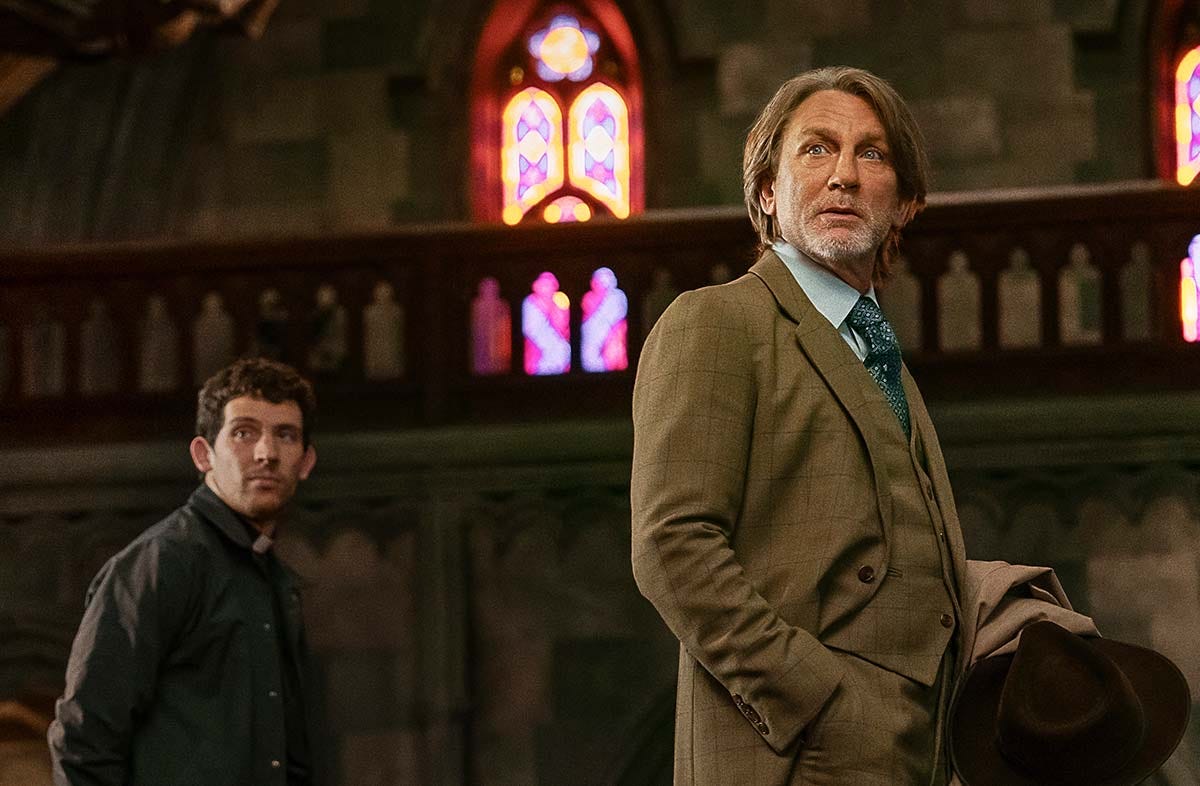
There’s several tensions at work in the new Knives Out movie, Wake Up Dead Man — religious belief vs nonbelief / atheism, innocence vs guilt, love vs hate, what a community looks like, what is the true Christian reaction to a sinful world, should a leader be a king or a servant, can a leader be both, since yearning for the position to lead signals an egotism regardless if one models oneself as a servant, what responsibility do we have to our parents and our grandfathers, to our children, to legacy, and what is legacy to begin with, and of course, the foundation question and tension that holds up every other one, what is truth, object fact or a story that a collective decides to believe in?
Rian Johnson is such a wonderful filmmaker that he manages to hold up all of these tensions in the film and address them with the appropriate level of comedy and seriousness that they all deserve. It is funny that an old woman drops to her knees in the dirt to declare that a farce is a miracle because she desperately needs to believe or needs others to believe that a miracle has happened, and a scene like that has to be played up as extreme and ridiculous, but on the other hand, a lonely woman needing someone to talk to about her dying mother deserves a seriousness and attention that seems to and should cut through the movie, reminding Father Jud, Benoit Blanc, and the audience, what is truly at stake beyond finding out who the killer is and how the murder was committed.
All the while, the movie feels like a movie. In the sense that it doesn’t yearn for realism and doesn’t try to sell itself as such, in the way that so many films and shows do, even genre ones, in order to feel like serious works of art. Johnson knows that a whodunnit should feel like one, like you’re entering into a different world with different rules, a world where Monsignor Jefferson Wicks feels larger than life, where his speeches are powerful not because he is speaking to some great truths, but because the people in his flock believe that he is, where Blanc is not a silly detective but someone after something of equal worth as Father Jud and anyone else attending the church. When at the end, Blanc has his “road to Damascus” moment, it doesn’t feel cheesy even though the light from the window shines on him to drive in the moment of revelation.
You can laugh, but you don’t dismiss him, because you’re in his world, their world, and in their world, that moment and the next moment matters. By leaning so much into the genre of these movies, Johnson creates films that are both fun and campy, but grounded in serious topics and tensions that it doesn’t shy away from. The film can laugh at the world because it also laughs at the world, and the intimate moments don’t feel undeserved because it has been earnest from the beginning.
This tension, this duality of comedy and drama, works so well because it’s especially embodied in the character of Blanc, who Craig plays so delightfully. The accent, the clothes, his manner of speaking, the way that he pokes fun at everyone and everything around him, while knowing that they’re all capable of doing the worst possible things to each other, and the way that he treats a murder like a game to solve, but also as something much more.
In one of the critical turns of the film, after being swept up in Blanc’s game to solve the murder, Father Jud realizes that he’s behaving the same as Wicks, looking for the “guilty” to judge and punish them, when he should be opening his arms and being with them, and he decides that he’s had enough. He pushes Blanc away and says to Blanc that Blanc doesn’t understand his work, and that to him, the murder and his work aren’t games in the same way that they are to Blanc.
That moment pointed to a very particular reason why the movie and series works so well. Blanc wasn’t just working to solve a murder, to finish a game that entertained him, he hounded Father Jud, rejecting his rejection, asking, practically beginning him to reconsider and continue his participation in the mystery, because it seems to me that his desires are as deep as anyone else’s in the movie, and that he himself represents a great tension that the films carry, the question of Justice.
Blanc comes into the case as an outsider, but he’s not objective. His introduction to Father Jud is the two of them arguing about religion, where Blanc states his position which embodies everything from his political to his moral positon. It’s not just that he doesn’t believe in a higher power, but he doesn’t like the harm that the church does to people, and often exploits their vulnerabilities. His actions also embody that morality. He doesn’t work with the police, he can’t because he and the police have different goals. The police want a perpetrator, they want to solve the case, lock someone up, and move on. That’s not necessarily justice, even if it wears the mask of it. For them it’s work, most of the time a game, but not for him.
In all of the movies, Blanc is on the side of the most vulnerable individual, even if at first it seems like they’re the guilty ones. He immediately recognizes that the structure of the case and the world is built to condemn the one that seems most obvious. He uses his skills, and the notion of truth, to counterbalance power and money. The fun of these movies isn’t in figuring out who the real killer is, that one is made pretty obvious and always comes to no surprise, it is about how Blanc is going to undo the construct that protects the one who did it while shielding the one that is being condemned.
He doesn’t just solve the cases, he is always solving it alongside someone, the person who has no one else on their side. It’s why when Father Jud goes to turn himself in, and Blanc notices him, Blanc pushes him out of the police station and when Father Jud almost confesses to what he thinks is the truth, Blanc plays the organ to shut him up.
Just as much as he unravels the mystery, he also keeps the police and the legal system away. He distracts, lies, and sabotages the police. He is their enemy, even if he first arrives like he’s there to help them. He plays dumb, and even at the end, he sacrifices himself, makes himself look like a fool to push them away, even for a moment, for justice to arrive, alongside mercy. Because his intention isn’t about putting a killer away and locking the door, because what he wants is truth, because his goals are more profound than who is guilty and who isn’t, just as father Jud’s mission is, he can create the space for an ending that grounds the film and expresses a better vision of humanity — even within all the carnage, lies, death, and deceit that can before — than simply throwing the perpetrator in the back of the police car.
Blanc acts as a detective in a whodunnit, but he’s also a shield against the possibility of a police procedural, and the cold way that the force of the state and the legal system divides and diminishes people. In that way, he’s doing the same kind of work that Father Jud is doing. He doesn’t need the Mass, the revelation, or the belief in a higher power. The film and the series work only because not because it’s an entertaining game for him, but because through his actions, as theatrical and ridiculous as they can be, you can see how much he cares for the people that he’s entangled with.
Happy Thanksgiving break to all my friends, comrades, coders, and luddites. Thankful for all of you readers fighting for the user out there. With that, here’s a special Black Friday edition of Blood in the Machine.
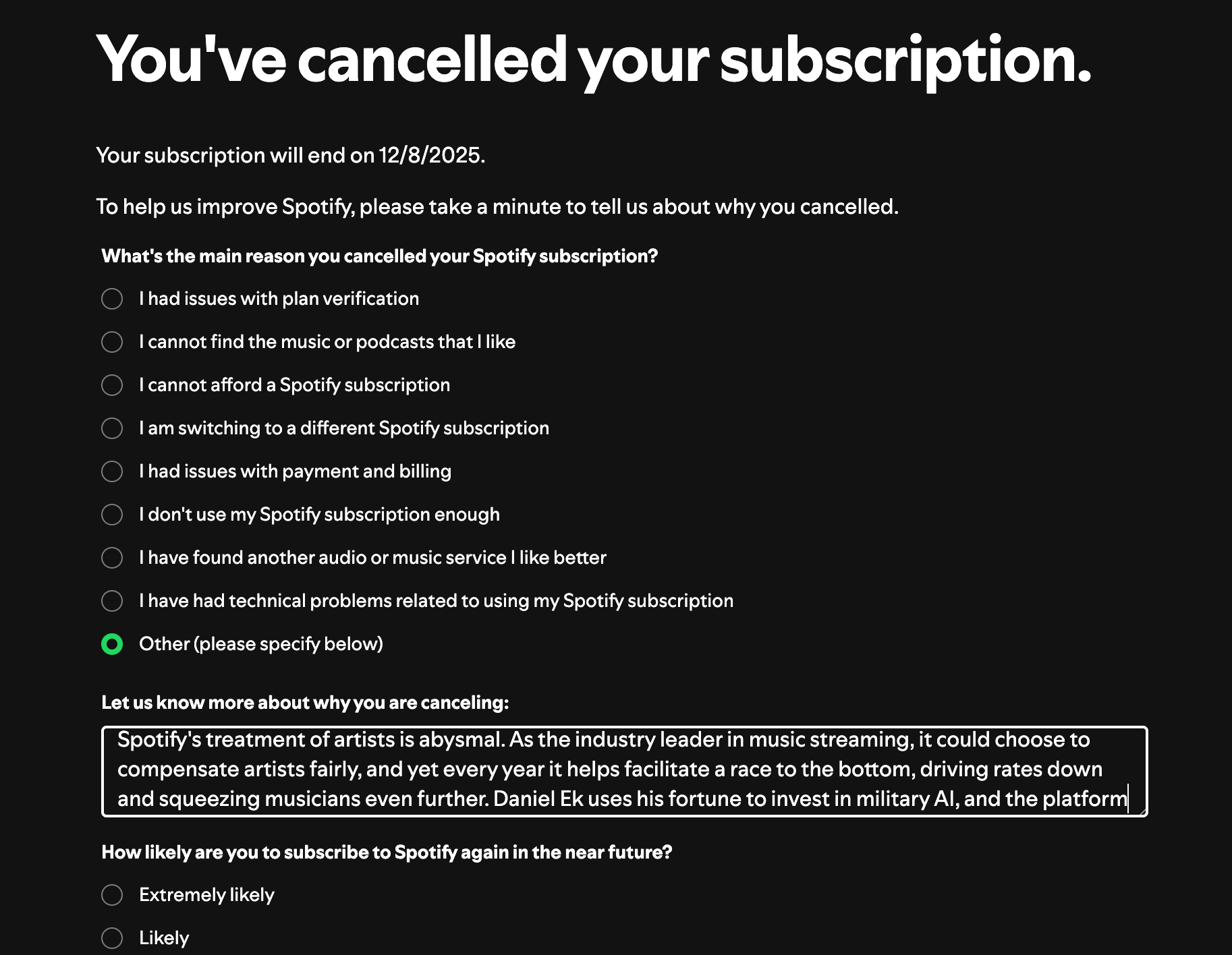
I finally cancelled Spotify. I’d been meaning to do this forever, and frankly I’m embarrassed it took me so long. Spotify has been driving down wages for artists far longer than the AI companies, reducing payouts for musicians over the years until most are now making a statistically meaningless amount from the platform; many estimates put the figure as low as $0.003 per stream. In 2024, Spotify stopped paying artists for songs that had fewer than 1,000 streams, despite the fact that 81% of musicians on the platform don’t cross that threshold.
Stories abound of successful artists with millions of monthly listeners who can’t afford to take a vacation, a break, or pay rent. The pop star Lily Allen says she makes more money selling pics of her feet on OnlyFans than she does from Spotify royalties. Meanwhile, Spotify just raked in nearly $700 million in quarterly profits. It’s rank exploitation. Don’t take it from me, take it from Bjork. Earlier this year, she succinctly described Spotify as “probably the worst thing that has happened to musicians,” thanks to how the company, and the streaming model it normalized, has so completely corroded artists’ incomes over the last decade or so.
Meanwhile, the company declines to label the AI songs that are overrunning the platform and even boosts them into Discover Weekly playlists, incentivizing their spread. Founder and CEO Daniel Ek used his Spotify fortune to invest in a lethal military tech startup, prompting the most recent round of artist boycotts from the platform. I could go on, but that will probably do—Spotify is everything that’s wrong with Silicon Valley’s engagement with culture and labor condensed into a single platform. Plus, the audio quality sucks.
Greetings from up on my high horse. I was just getting warmed up, too.
So why didn’t I go sooner? I justified staying by telling myself I’d use Bandcamp to buy the albums and songs I listened to a lot, which I did, while using Spotify for convenience. That, and the same reasons I still use Gmail: I felt locked in (all those saved songs and playlists) and that the costs of switching would be too high (I would surely lose access to countless songs by switching over). But I am here to tell you today that both of those counts are absolutely false.
I’ve spent the last few days nursing a cold, and figured that I’d use some of that time to test out Spotify alternatives and finally take the plunge. I am extremely glad I did; it’s been a minute since I’ve felt something approaching genuine delight in discovering a new tech service.
So, in time for Black Friday—some of the Spotify alternatives have specials and sales going right now—here’s the Complete BLOOD IN THE MACHINE Guide to Getting Off Spotify.
As always, this work is made possible by the percentage of readers who chip in $6 bucks a month (or $60 a year). It is for you, dear readers, that I spend my sick days listening to new Geese tracks, Prince reissues, and Black Sabbath remasters on various streaming platforms (and not at all for myself), and I very much appreciate your support. If you can afford to, and you find value in this work, please consider joining the ranks of the hammer wielders. Many thanks, and onwards.
First, download Bandcamp if you have not done so already. The best way to support artists is to purchase their music directly, and even if the company has been through some rough waters lately, Bandcamp remains the most convenient way to buy music online and keep it in one place.
Second, I would recommend considering what’s important to you in a streaming platform. Audio quality? Library depth? Fairest payments to artists? Recommendation algorithm? It not being owned by a vampiric billionaire or operated by an extractive tech monopoly?
While you’re thinking about that, let’s assuage those two concerns about switching that you likely share with me.
You are not locked into Spotify even a little bit
Your music library is much, much more portable than you think. It will cost you from $0-10 to have a service like Soundiiz automatically transfer your playlists from one service to another. It’s so easy. The platform that I wound up switching to had a deal that let me do this for free. The permissions Soundiiz asked for were not at all onerous, and it took like 5 minutes. Total. I had around 200 playlists, hundreds of albums and artists saved, and several thousand songs and albums favorited. It all ported over seamlessly.
If you’re worried about your meticulously compiled playlists, I would say: Do not at all be. They’ll port over fine. And nearly every single song will still be here, because:
Spotify’s library is not that much better than anyone else’s
This was honestly the biggest surprise. On most streaming services I tried, I found nearly everything I was looking for. That surprise could be due to a long outdated misconception I had, or because AI has fried my brain for the last two years, but I was fully expecting Spotify to at least beat the competition in song selection. But nope, not really. There just wasn’t much deviation, and when I transferred my playlists, I only lost at most a song or two on each. And I listen to some admittedly pretty weird stuff! I did not really expect to find, say, Fluisteraars albums everywhere; either the world has suddenly gotten into Dutch experimental black metal, or it’s simply become easier for artists to upload songs to more platforms.
Okay, so you can transfer streaming libraries nice and easy, and selection isn’t really going to be an issue. Before we break down the alternatives, let’s talk about artist royalties. Most companies publish statements about how they calculate payments, but very few publish the actual rates they pay (there’s one exception, which we’ll get to in a second here), so it’s up to independent auditors to try to track down real numbers. Most streamers also send the payments to the rightsholders, so for musicians on record labels, there are further cuts scooped out.
Benn Jordan, YouTube.
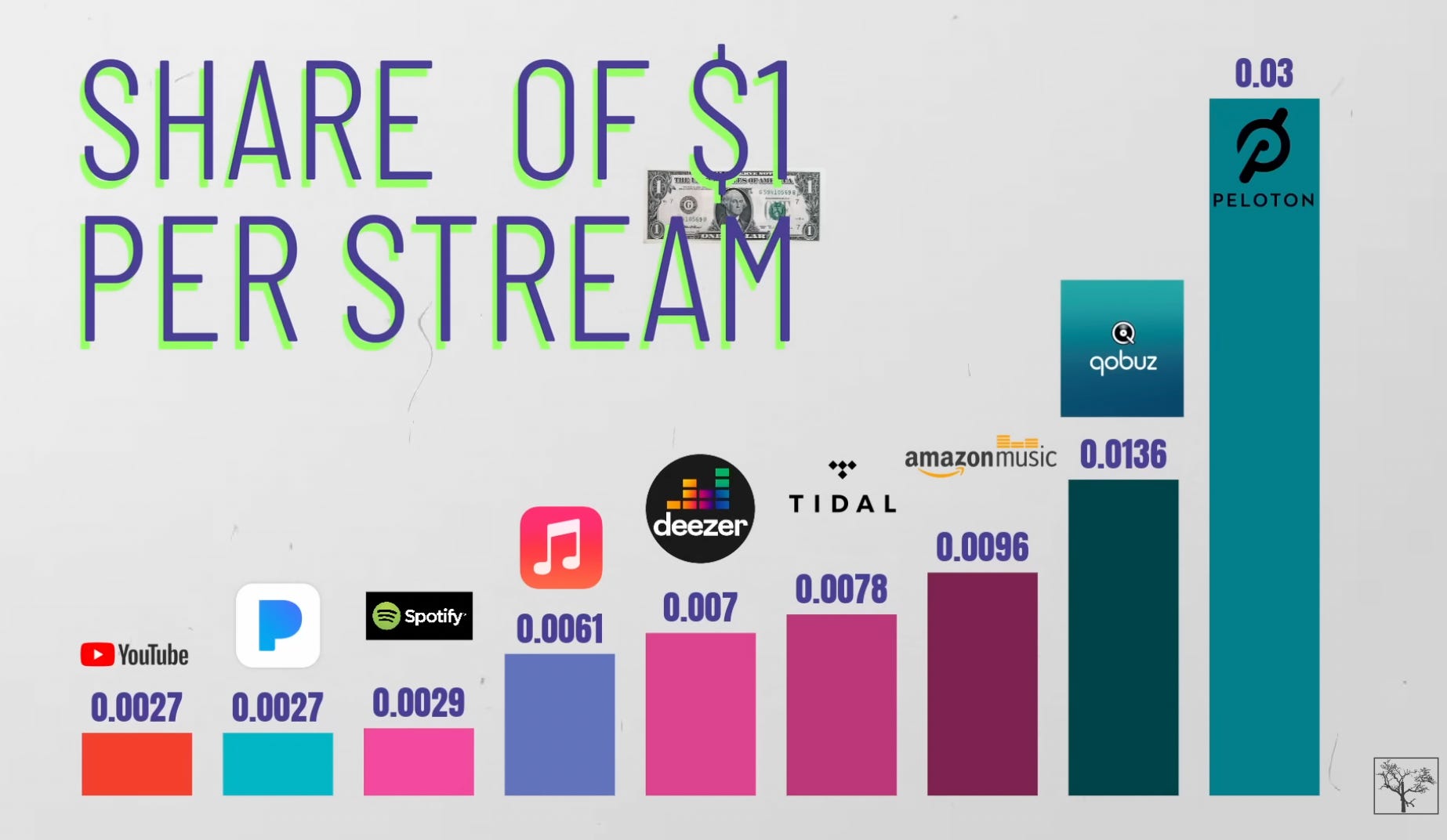
I found this YouTube segment from the independent musician Benn Jordan really interesting. Since he’s indy, he gets the payments directly, and he put together this breakdown of what the streamers paid him.
Okay, with all that in mind, here’s a dive into the streaming platforms I’ve tried, and my choice of best, most artist-friendly streamer.
Apple Music
Apple Music is the closest thing there is to a straight-up Spotify clone, from my survey, anyway. I used a free trial, and it was fine. It had (nearly) all the music I wanted, audio quality was fine, and the user interface is intuitive. If you use lots of Apple stuff you’ll know what to expect and you probably already have an Apple Music account. I was a little curious to see if the notoriously prude Apple would censor graphic album art like the gory stuff on Cannibal Corpse covers, but I can report here that it did not. Apple pays artists $.006 a stream, which, while quite actually twice as much as Spotify, still kind of sucks. Plus, Apple is Apple, and you’re still handing your music money to a tech giant run by Tim Cook, who was most recently spotted at the White House’s investment forum for Saudi Arabia.
Tidal
Tidal was pretty good, actually. Artist pay is $0.008, which is better than Apple, and it seemed to demonstrate a little genuine appreciation of music; there was a contest running on the home page for undiscovered artists when I logged on. The audio quality is noticeably better than Spotify and Apple, and the user interface is OK, even if it’s a little inert. However, Tidal is also the most volatile major music streamer. It has a wacky history; it started in Norway, was bought by Jay Z, who is still a minority stakeholder, and at one point was partially owned by the now defunct telecom Sprint. It was eventually bought by Block, formerly Square, the Jack Dorsey-led payment processing company, and laid off 10% of its staff in 2023. The company is apparently currently without a CEO, so it is presumably de facto being led by Dorsey, a man who once said of Elon Musk, “I trust his mission to extend the light of consciousness.” As a result, I do not trust Tidal.
YouTube Music
You have to work pretty hard to be worse than Spotify on all counts. In my admittedly brief tour of YouTube Music, audio quality was bad, it was unappealing to use, and it somehow pays artists even less than Spotify ($0.0027 per stream). Next.
Pandora
I was a little surprised that Pandora, a true mainstay of the 00s’ “music is on the internet now” novelty era, was still around. Alas, it also pays artists complete garbage ($0.0027), and since all the major streamers do the vibes-based playlist thing now too, I’m not really sure what Pandora’s value proposition is.
Deezer
The French streamer apparently pays a bit better than the pack ($0.007), and it seemed fine, too, foregrounding its offerings of Pandora-but-pure-mood playlists like ‘Flow’ and ‘Love’. It would be a suitable alternative, perhaps, if it wasn’t for what, in my opinion, is the hands-down best music streamer there is right now.
Qobuz
I spent about 20 minutes on the unfortunately named Qobuz, and I was sold.
First, the artist pay is the best in the biz (except, for some reason, for Peloton’s in-house streaming service). It’s $0.0138, which means it’s more than a penny a stream. Receiving Qobuz’s pay report, the indy musician and analyst Jordan says, “was the first time I looked at streaming royalties and felt fairly compensated.” (The company is also the first to publish its own average payout report, and make its figures public—it cites $0.01873 as its average. A thousand streams means the artist makes ~$19.)
Second, the audio quality is great. I listened to a little bit of everything to test it out, and especially after the flat, compressed sound of Spotify, I didn’t want to stop. It’s got an icon for when albums are available in 24-bit/96 kHz, high resolution format, and it kills. On Qobuz, the Replacements’ Let It Be is raw and crackling, the Flaming Lips’ Soft Bulletin is lush and beautifully layered. Master of Puppets sounds huge. The (great) new Robyn track Dopamine is crisp and prismatic. Qobuz’s album of the week was a remastered drop of Prince’s Around the World in a Day; it’s majestic. Also that new Geese album everybody likes really is good and sounds great steaming, too.
Third, and the thing that really resonated with me the most, perhaps, was that the people who run Qobuz actually seem to… like music? On the app, along with its Discover and Playlists tab, there’s a Magazine tab with interviews and features. I’m not sure I’ll spend a ton of time reading them, but after years of the algorithmic sludge and pop-up payola recommendations of Spotify, it was refreshing to read thoughtful articles celebrating, say, the post-rock icons Tortoise, Quincy Jones’ catalog, and a Kantō speaker system. I also love how Qobuz lists the record label along with the song title, artist, and it’s clickable, so you can go right to the label to find other bands and so on. There’s *also* no streaming number listed, perhaps because it would be rather low given the relative size of Qobuz’s platform, but I found it refreshing as there is therefore no way to snap-evaluate a song based on its stream count.
This was a nice way to encounter the artists who’ve bailed on Spotify, or, those, like Joanna Newsom, who’ve never relented and let Spotify stream their music in the first place. I bought some of Newsom’s albums on Bandcamp way back when, but I only realized now just how little I’ve listened to them because she wasn’t on Spotify, and how shitty that is. I gave King Gizzard and the Lizard Wizard and Massive Attack a spin, too, since they and dozens others have ditched Spotify over Ek’s investments in Helsing, a German military tech and drone company.
So yeah, I’m having a great time with Qobuz, both because the product is genuinely better than Spotify, and because it feels like sweet release to be free of that shitpit. There are shortcomings, of course—it’s not Siri-compatible, so it won’t work with CarPlay hands-free. It takes longer to load songs and the UI is clumsy on mobile. It isn’t as seamless as some other apps. (I also listened mostly on my laptop, as opposed to mobile, and that’s worked great for me.) But those are minor things. More importantly, let’s not have any illusions here: Qobuz, while operated by music biz folks who seem driven (or see an opportunity) to put artists and music at the forefront and de-emphasize the algorithm, is owned by a multimedia conglomerate SA Xandrie, and has completed multiple $10 million plus VC rounds. It’s not some scrappy artists’ collective that can be counted on to keep musicians’ pay decent and AI sidelined. But for now, Qobuzz is great.
And there you have it: An official Blood in the Machine endorsement for ditching Spotify, and trying out a more ethical, better-sounding alternative.
Other BITM-approved gifts for Black Friday and beyond
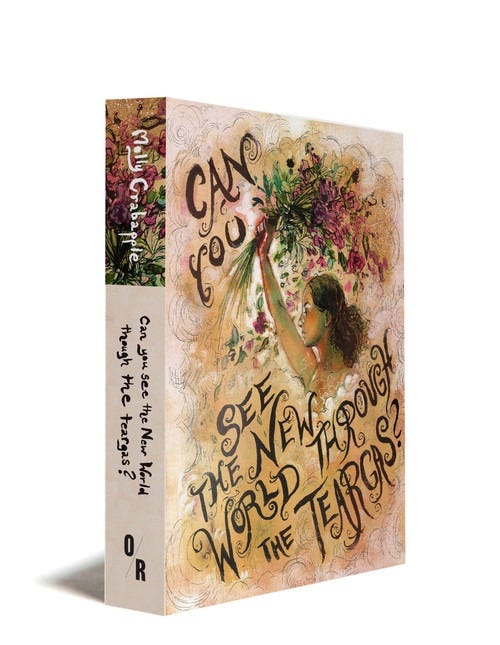
Friend of the blood, artist, AI critic, and fellow ludd Molly Crabapple has a beautiful new set of illustrated cards out in a set called Can You See The New World Through The Teargas? from OR Books.
The designer Bart Fish has been publishing a great series of strikingly visualized critiques of AI at Power Tools. He’s publishing them as a zine, too; you can order one for a pay-what-you-can donation here. They look amazing:
Finally, the e-reader edition of Blood in the Machine: The Book is, I’m told, on sale at Amazon. Under normal circumstances, that’s not exactly the ideal place to get it, but seeing as how Amazon is certainly taking a loss on the sale here, so by all means, get it for cheap.
OK! That’s it folks. Have a nice holiday weekend, keep that hammer high, and see you all again soon.
The mission is simple: spend less time looking at my phone. I’ve made several adjustments to my information diet and to how I consume content online, but many of these changes made me even more tethered to my phone. So I set out to read more on my e-reader instead of constantly staring at my phone.
Put the phone down
First, a brief detour into my browsing and reading habits. I subscribe to a lot of feeds (check out my blogroll!) and going through my RSS reader gives me a similar dopamine hit to scrolling on social media - except I’m mostly learning something new rather than just being entertained. But it also means I spend a lot of time staring at my phone and reading articles on it, which is definitely not a good way to read anything, and it does not feel great either. Besides, you’re one notification away from being pulled out of your reading.
The allure of the phone is strong: everything is at hand and frictionless. If I want to replace it with something else, it has to be similarly easy to use. This rules out using a computer, since I don’t always have one with me and the startup time is considerable even on modern machines. I guess that leaves me with the only option: printing everything on paper and reading that way.
Okay, I’m kidding, but the solution is a bit like paper: it’s an e-ink reader. I currently have a Pocketbook Verse Pro and I love reading on it. The goal would be to have an easy way of taking anything noteworthy (and usually long-form) and transferring it to my e-reader. Most importantly, this is not a Pocketbook-specific solution: in fact it will work on any reader with KOReader installed, meaning it could be your Kobo or Kindle too.
It sounds like a lot of hassle
It does, but let me explain. Once everything is set up, this is actually a very smooth experience. Frictionless.
There are two major sources of friction:
Getting the content into the e-reader
Removing the content from the e-reader once finished (keeping things tidy)
Conveniently, both problems are solved by Wallabag, which will be familiar if you know Pocket or Instapaper. Wallabag is an open-source “read it later” app, and it is by design self-hosting-friendly, even though you can use it as an online service directly from wallabag.it too. It will serve as the home for all content worthy of proper reading and thus be the backbone of this setup. And because KOReader already integrates with Wallabag, receiving and archiving articles is quite seamless.
The one-tap solution
The end state looks like this: I am going through my RSS feeds on my phone, and if I see something long-form that I’m interested in, I tap on the “Star” button and move on until I have enough articles to read. In a few minutes, I can pick up my e-reader, sync new articles and start reading said articles. During the next sync, the already finished articles will be removed from my device (unless I mark them as not finished).
The one remaining missing piece is a Python script that periodically fetches newly starred (“favourited” in FreshRSS speak) articles from FreshRSS and pushes them to Wallabag. Below you will find both instructions on how to set the whole pipeline up, and the code for the script.
The way the script works is by connecting to FreshRSS to fetch favourited articles, comparing it to a local list of already processed articles, and adding the new ones to your Wallabag instance to be picked up by KOReader. It’s a really simple script that ties this all together. It will also keep producing rotating sync.log files to make any potential troubleshooting easier.
Below is a breakdown of what happens under the hood:
Setting up the pipeline
Pre-requisites
A server or computer (with Python 3 installed) to run the script periodically.
First, you have to enable API access in your FreshRSS instance. Make note of your user’s API password. You can verify if the Fever API is enabled by going to https://foo.bar/p/api/, assuming https://foo.bar/ is the root path to your FreshRSS instance.
Wallabag setup
Next, you have to set up API keys to access your Wallabag instance. Log in to Wallabag and go to API clients management section, where you need to create a new client. I personally created separate clients for my Python script as well as for my KOReader and Wallabagger extension (see below), but you could reuse the same client credentials if you prefer. Note down the Client ID and Client secret.
Sync script setup
The script for syncing articles between FreshRSS and Wallabag can be found in this GitHub repo. Download the .py file and the config.json.example to your server, put them in the same folder, rename the latter to config.json and update its values. You should also chmod 0600 the config.json file or otherwise make sure that it’s safe from prying eyes, since it will store your API credentials.
Tom, you dummy, why not just use a .env file? Everyone knows that’s where secrets go!
Yes, and you’d typically load it using python-dotenv — a module you’d install via pip, which may not even be installed on your machine. Writing my own parser for dotenv files would unnecessarily inflate the length of this script and could lead to unforeseen bugs on different systems. The goal here was to make this as portable as possible, requiring nothing but a Python interpreter, which is almost universally available. This is simply the path of least resistance, and as long as you keep the permissions tight, it is as safe as a .env file.
Okay, now as long as you’ve edited your config correctly, you can try running the script to see if you can connect to both APIs. You should see something like this:
[2025-11-25 23:30:02] INFO: Starting FreshRSS → Wallabag sync
[2025-11-25 23:30:02] INFO: Previously synced: 0 articles
[2025-11-25 23:30:02] INFO: Found 0 starred articles in FreshRSS
[2025-11-25 23:30:02] INFO: No new starred articles to sync. All up to date!
Now it’s time to go to FreshRSS, mark an article as favourite, and re-run the script to see if it gets synced to Wallabag.
Tom, I see you’re storing the previously synced article IDs in a local json file. That’s kind of dumb!
It is! But also it’s beautifully simple and functional. A setup using SQLite would surely be more scalable, but how many articles will you favourite per year? Dozens? Hundreds? This probably gives the script centuries before it starts becoming a problem. Let’s not overengineer things.
Now that your script is up and running, don’t forget to add it to your cron, or a similar solution to periodically run it. I’m using Synology’s Task Scheduler and have set the frequency to 15 minutes.
KOReader setup
Now that articles are getting beamed up to Wallabag, it’s time to set up your e-reader. KOReader supports Wallabag natively, and it’s easy to set it up using the official wiki. I highly recommend saving the empty settings and editing the Lua file on your computer. Typing all the credentials on the e-reader keyboard is no fun.
Once you have Wallabag set up, syncing should download the articles:
I also highly recommend going to Wallabag settings in KOReader, open the section Remote mark-as-read settings and enable the following options:
Mark finished articles as read
Mark 100% read articles as read
Auto-upload article statuses when downloading
This will automatically delete any read articles from your e-reader and mark them as read in Wallabag whenever you sync. You do not have to manually clean anything up - brilliant!
[Bonus] Wallabagger setup
Now that we have a pipeline that feeds our e-reader, we might as well use it in other useful ways. Wallabagger is a Chrome and Firefox extension that saves articles directly to your Wallabag instance. This gives you freedom to shoot any articles you got sent or found in newsletters etc. straight to your e-ink device.
When you install Wallabagger, you have to set it up to connect to your Wallabag instance (hit Check URL) and then provide Wallabag client credentials. You should also tick the option Retrieve content from the browser by default when saving page, otherwise Wallabagger will only save the link itself and some metadata.
Support open-source!
All of this is possible only thanks to open-source developers of the above applications. While you can subscribe to Wallabag’s hosted solution and support them that way, I suspect many of my readers will dabble in self-hosting.
Below are links to the Liberapay accounts where you can support the applications:
One of my best mates regrets moving to Austin. The job didn’t work out, the culture wasn't what they expected, and now he’s planning to move back to New York within the next year.
He had an offer for a role that paid 40% more than his New York position, the cost of living was dramatically lower, and he’d been complaining about New York winters for the better part of a decade. The job collapsed because of funding issues that nobody could have predicted. The culture mismatch was real, but how could he have known without trying?
The question he asked me: did he make a bad decision?
We conflate the quality of our decisions with the quality of their outcomes so automatically that we rarely notice we're doing it. A good decision that leads to a bad outcome gets reclassified in our memory as a bad decision. A terrible decision that happens to work out becomes evidence of our brilliant judgment. We are constantly running our own internal kangaroo court, retroactively convicting or acquitting our past selves based solely on how things turned out.
Thinking in bets offers a way out of this trap.
When you frame a decision as a bet, you're forced to explicitly acknowledge that you're operating under uncertainty. You have to assign some probability to different outcomes, however rough. You have to think about expected value rather than guaranteed results. My friend made a bet that had, let's say, a 70% chance of working out well and a 30% chance of not working out. He lost the bet. That doesn't retroactively make it a bad bet.
This might sound like motivated reasoning, a way to excuse bad judgment by claiming "well, it seemed like a good idea at the time." But the difference is that thinking in bets forces you to be honest about what you actually knew at the time versus what you learned afterward. If you claimed there was a 95% chance of success when any reasonable analysis would have suggested 50/50, you made a bad bet regardless of the outcome. If you carefully weighed the probabilities and made the choice that maximized your expected value, you made a good bet even if you got unlucky.
Professional poker players understand this viscerally. You can play a hand perfectly and still lose because someone hit their 8% draw on the river. You can play terribly and win because you got lucky. What separates good players from bad players over the long run is the quality of their betting decisions, not the outcomes of individual hands. Good players lose hands all the time. They just make sure they're making +EV (positive expected value) bets when they do.
Think about how differently we might approach major life decisions if we thought about them probabilistically. Instead of asking "should I take this job?" you'd ask "what's my estimate of this working out well, and given that probability, what's the expected value compared to my alternatives?" You might still take a risky job if it has high enough upside and you have a decent chance of success, even if failure is a real possibility.
When you make a binary decision, admitting you were wrong feels like admitting you're bad at decisions. When you make a probabilistic bet, being wrong just means you were on the losing end of the odds this time. You can simultaneously acknowledge that the outcome was bad while maintaining that the decision was sound.
This has downstream effects on how you learn from experience. If every bad outcome is evidence of bad judgment, you'll be motivated to rationalize or minimize your failures. You'll be reluctant to take reasonable risks because any failure will be counted against you.
But if you can separate decision quality from outcome quality, you can look at your failures more honestly.
You can ask: did I misjudge the probabilities? Did I have information I should have weighted differently? Or did I actually make a good bet that happened not to pay off?
There's a trap here, though.
Isn’t there always…
You can't just assign whatever probabilities make you feel good and then claim you're thinking clearly. The probabilities have to be calibrated to reality, which means tracking your predictions and adjusting when you discover you're systematically over or underconfident. If you keep saying things are 80% likely and they only happen 50% of the time, you're not thinking in bets so much as you're using probability as a fig leaf for wishful thinking.
When you apply this consistently over time, you start noticing patterns in the types of bets you make. Maybe you're too conservative about career moves but too aggressive about financial risks. Maybe you systematically overestimate your ability to finish projects quickly. These patterns are much harder to see when you're thinking in binary terms, where every decision is either vindicated or condemned by its outcome.
Some people resist thinking this way because it feels cold or calculating. Where's the room for intuition, for gut feelings, for the ineffable sense that something is right? But probabilistic thinking doesn't exclude intuition. Your intuition is providing you with information, you're just being more honest about the uncertainty inherent in that information. When something feels right, you might update your probability estimate upward. You're just not pretending that your intuition provides certainty when it doesn't.
Others worry that thinking in bets will paralyze them with overthinking. If you have to calculate expected values for every decision, won't you waste enormous amounts of time on analysis? But you can think in bets at whatever level of precision the decision warrants. Choosing where to get lunch doesn't require a spreadsheet. Choosing whether to go to graduate school might benefit from one. The framework scales to the stakes.
What happens when you extend this thinking to your beliefs more generally, beyond just decisions? You start saying things like "I'm about 60% confident that" instead of making definitive pronouncements. You become more comfortable with uncertainty. You can hold multiple contradictory hypotheses in your mind simultaneously, weighted by probability. When new evidence comes in, you update your probabilities rather than either ignoring the evidence or completely reversing your position.
The world contains more uncertainty than we're comfortable acknowledging. We want to believe that if we just think hard enough, gather enough information, and make the right choice, we can ensure success. We want to believe that good decision-making guarantees good outcomes. But it doesn't. Sometimes you make the best possible choice given the information available and things still go sideways. Sometimes you make a questionable choice and get lucky.
Thinking in bets lets you make peace with that uncertainty without surrendering to fatalism. You can take responsibility for the quality of your decisions while acknowledging that outcomes are probabilistic. You can learn from your failures without assuming that every failure represents a personal deficiency. You can take reasonable risks without being paralyzed by the possibility of loss.
My mate made a reasonable bet that didn't pay off. He’s not stupid for having moved, and he’s not stupid for moving back. He gathered information, updated his probabilities, and made a new bet based on what he learned. That's exactly what thinking in bets looks like in practice. It's messy, it involves backtracking, and it doesn't guarantee success.
But it gives you a fighting chance of making good decisions in a world that refuses to offer you certainty.
 Log in